Graph-visible delegation
Follow contacts, jobs and tools through queued, active, waiting, done and failed states.
CHAT · GRAPH · APPROVALSHarness OS gives local and cloud models stable identities, bounded workspaces, observable delegation, and a shared interface for language and creative compute.
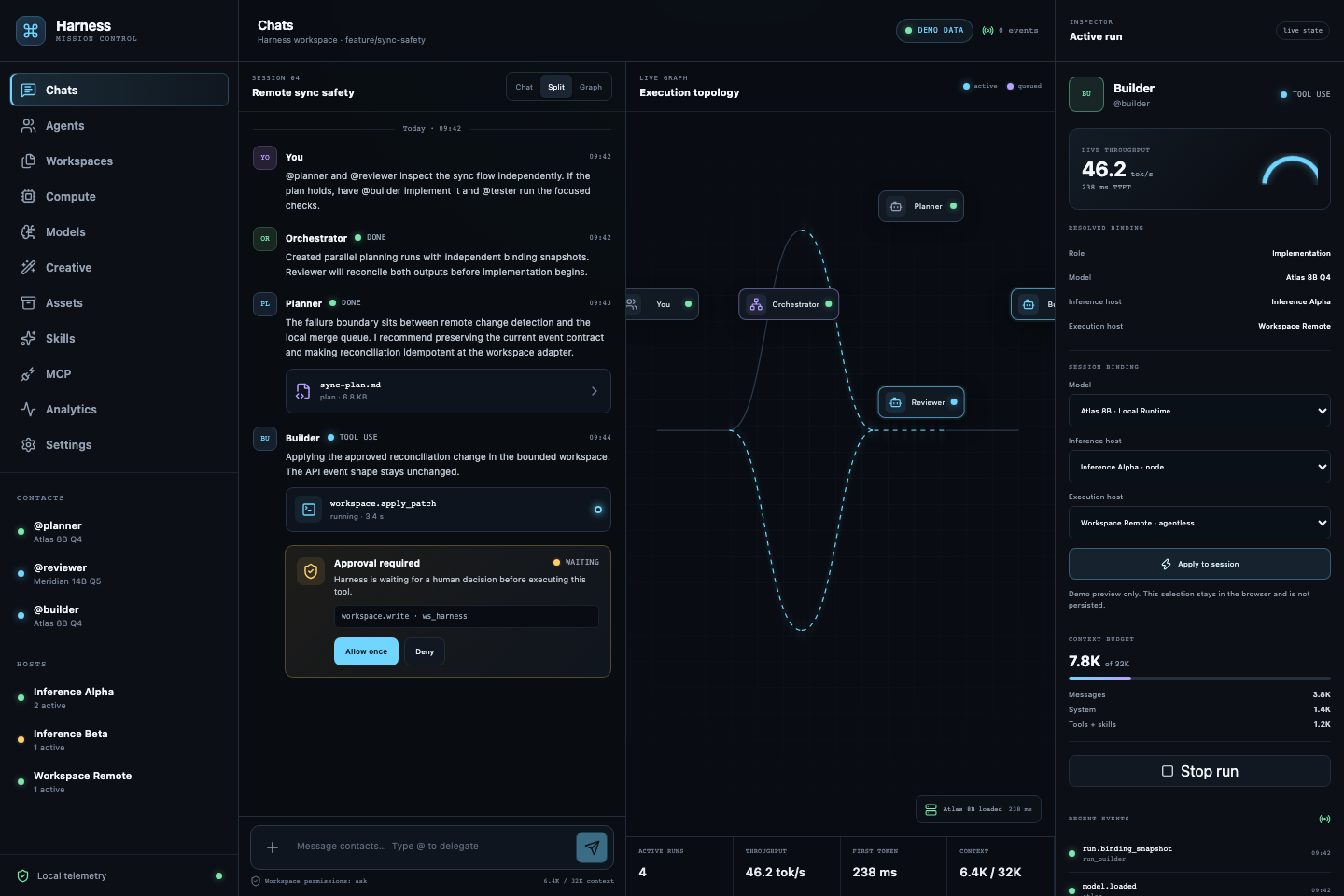
The production WebUI is an API client, not a static dashboard. It reads versioned Harness resources, follows the event stream, and sends user actions back through the control plane. A deterministic mode provides network-free evaluation and repeatable visual checks.
Follow contacts, jobs and tools through queued, active, waiting, done and failed states.
CHAT · GRAPH · APPROVALSSee inference, execution, creative and Harness hosts as distinct resources with their own pressure.
HOSTS · MODELS · TELEMETRYBrowse files, inspect worktree state, review output and submit changes through the workspace API.
FILES · GIT · ARTIFACTSInspect load state and history, then apply runtime settings through instance endpoints.
LOAD · UNLOAD · SETTINGSTrack engine capability levels, reusable profiles, generation jobs, batch comparisons and provenance.
ENGINES · QUEUE · ASSETSSkills and MCP tools expose compact indexes until the user or runtime chooses what to activate.
SKILLS · MCP · PERMISSIONSA Contact remains recognizable while its model, provider, inference host and execution host can change. Every run can preserve the resolved binding snapshot for review and benchmarking.
Mention contactsCompose a parallel or sequential workflow in plain language.
Review the live graphInspect delegation, tool activity and infrastructure events.
Approve consequential workAllow once or deny at the point of execution.
@planner and @reviewer inspect the sync flow independently.

If the plan holds, have @builder implement it and @tester run the focused checks.
The one-shot build covers most of its specification in typed source, API routes, two clients, deterministic fixtures, and CI. The specification's Definition of Done is still a requirements document—not a signed-off live acceptance record.
Versioned FastAPI and events, SQLite, Contacts and bindings, providers, SSH workspaces, permissions, artifacts, creative adapters, analytics, optional Node, WebUI, TUI, demo mode, and packaging.
Exercise supported providers, SSH hosts, creative runtimes, node telemetry, authentication, and the full phone-to-workspace journey on real infrastructure.
Record a checked acceptance matrix, harden install and upgrade paths, document adapter limits, and keep the API, generated client, WebUI, and TUI aligned.
Expand provider and creative support only from measured capability evidence; preserve the future mobile-compute hook without claiming a native mobile node.
The responsive WebUI keeps three panels on desktop, at least two useful panes in iPhone landscape, and a fully actionable chat with slide-over sheets in portrait.
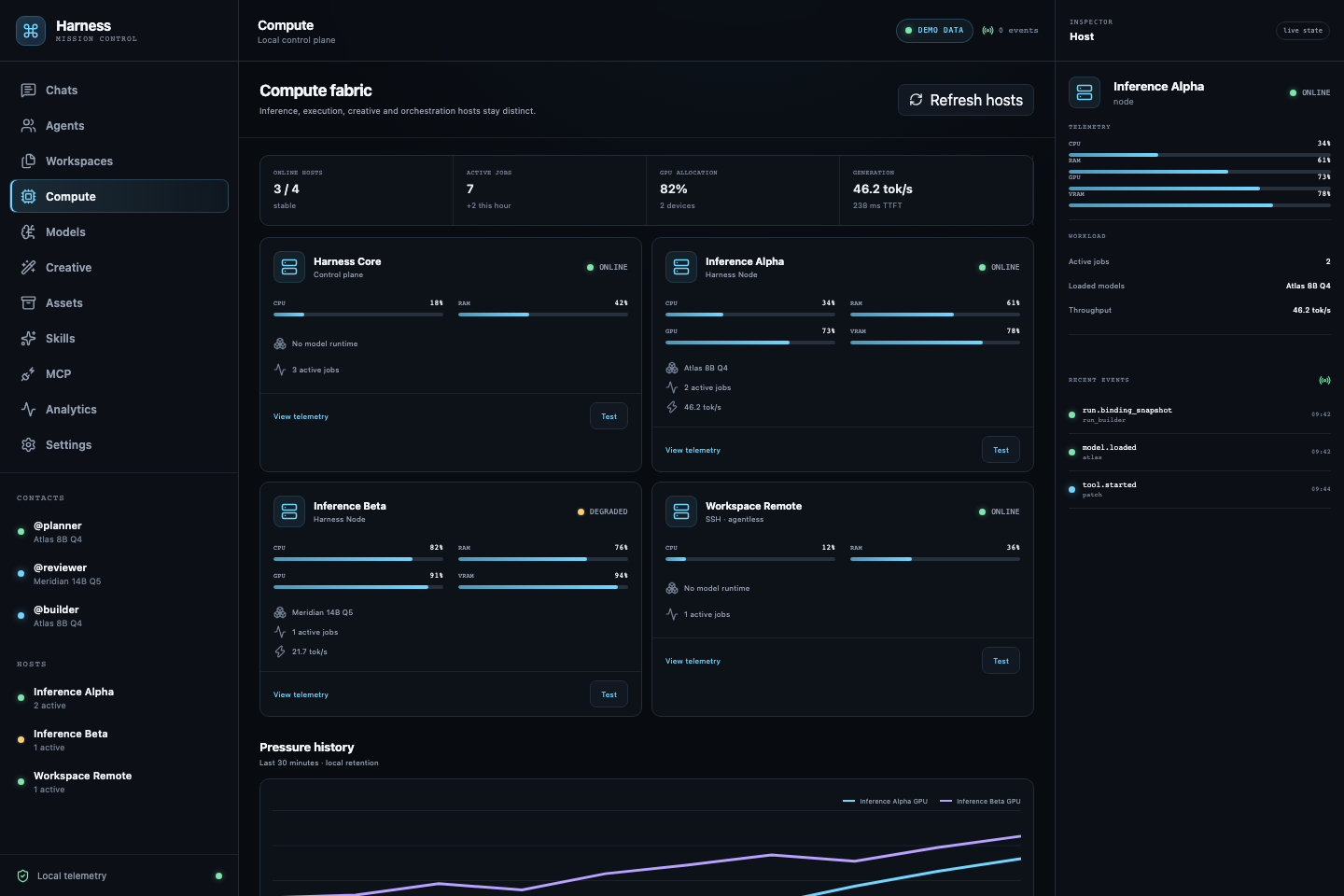
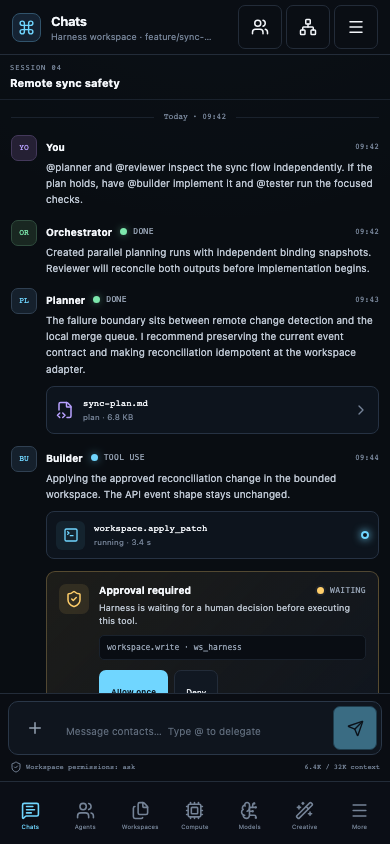
The Pages site documents the project. It does not impersonate the Harness server. Run the WebUI beside Harness on a deliberately configured private network, with authentication enabled for non-loopback access.